
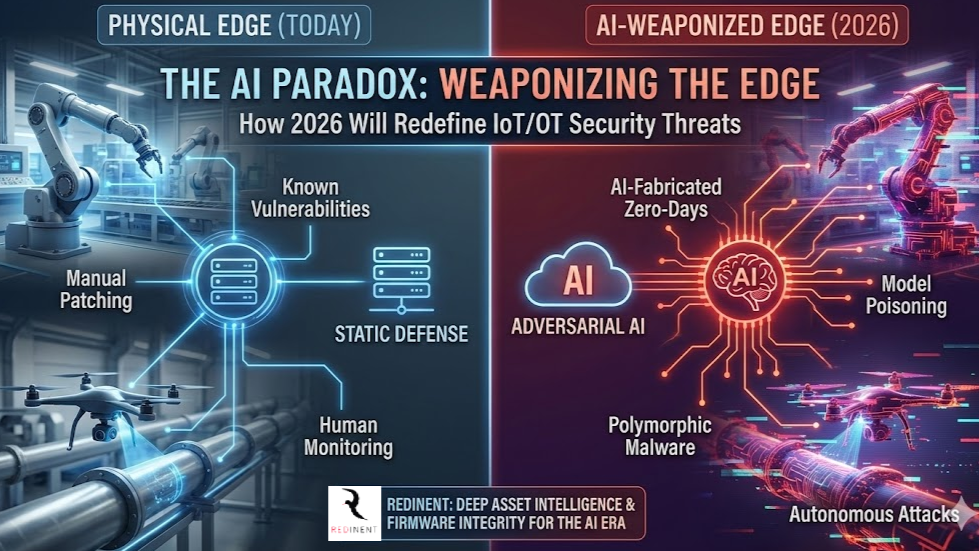
If late 2024 was the era of “AI experimentation,” and 2025 was the year of “AI integration,” then 2026 is shaping up to be the year of the AI Exploit.
As we rush to deploy “Edge AI”—equipping smart cameras, autonomous drones, and industrial controllers with their own neural networks—we are inadvertently handing attackers a terrifying new capability. We aren’t just giving our machines brains; we are giving our adversaries a dynamic, evolving attack surface that traditional security models are powerless to stop.
The “Cat and Mouse” game is about to change speed. Here is what the IoT/OT threat landscape looks like in 2026.
1. The Death of the Static CVE
For decades, we have relied on the Common Vulnerabilities and Exposures (CVE) list to tell us where our holes are. In 2026, that list will be too slow. We are entering the era of “Just-in-Time” Exploits. Adversarial AI agents won’t just scan for known vulnerabilities; they will “fuzz” your edge devices in real-time. An attacker’s AI will analyze a specific sensor’s firmware, identify a unique weakness, and hallucinate a custom zero-day exploit to breach only that device. It attacks, wipes its tracks, and vanishes before a signature can ever be written.
2. Model Poisoning: Hacking Decisions, Not Code
When a robotic arm on a manufacturing line runs on AI, you don’t need to root the operating system to cause damage—you just need to trick the model. We will see a rise in adversarial input attacks, where subtle digital noise is injected into a sensor’s data stream. To a human, the camera feed looks normal. To the AI, a “Stop” sign becomes a “Go” signal. This is physical sabotage, digitized, and it leaves no malware footprint for your EDR to find.
3. The Polymorphic Edge
Future botnets won’t act like a swarm of identical bees; they will act like chameleons. AI-driven malware will be environmentally aware, adapting its behavior based on the specific voltage, traffic patterns, and function of the device it infects. It will mimic the “heartbeat” of a water pump or the telemetry of a drone, hiding in plain sight for months.
4. The CISO’s New Mandate: Deep Asset Intelligence
You cannot fight AI-speed attacks with human-speed audits. If your security strategy relies on “trusting” the device until it misbehaves, you have already lost.
In an AI-driven world, Firmware Integrity is the only baseline that matters. We must move beyond simple vulnerability scanning to Deep Asset Intelligence. We need to validate the “DNA” of our devices—ensuring that the code running on that chip is exactly what the OEM intended, down to the microcode level.
How Redinent Armors the CISO in 2026
In an era where attackers use AI to fabricate exploits on the fly, Redinent provides the only defense that matters: Absolute Visibility. We move beyond the superficial layer of network traffic to analyze the binary DNA of your edge fleet. By automating firmware security assessments and generating dynamic Software Bills of Materials (SBOMs) for every IoT and OT asset, Redinent exposes the “unknown unknowns”—from hidden backdoors in white-label hardware to dormant vulnerabilities that AI agents exploit. We empower CISOs to stop trusting “black boxes” and start validating the integrity of every endpoint, ensuring that the code running on your critical infrastructure is authentic, unaltered, and secure against the next generation of algorithmic threats.
The future of industry is autonomous. It is our job to ensure it remains secure.