
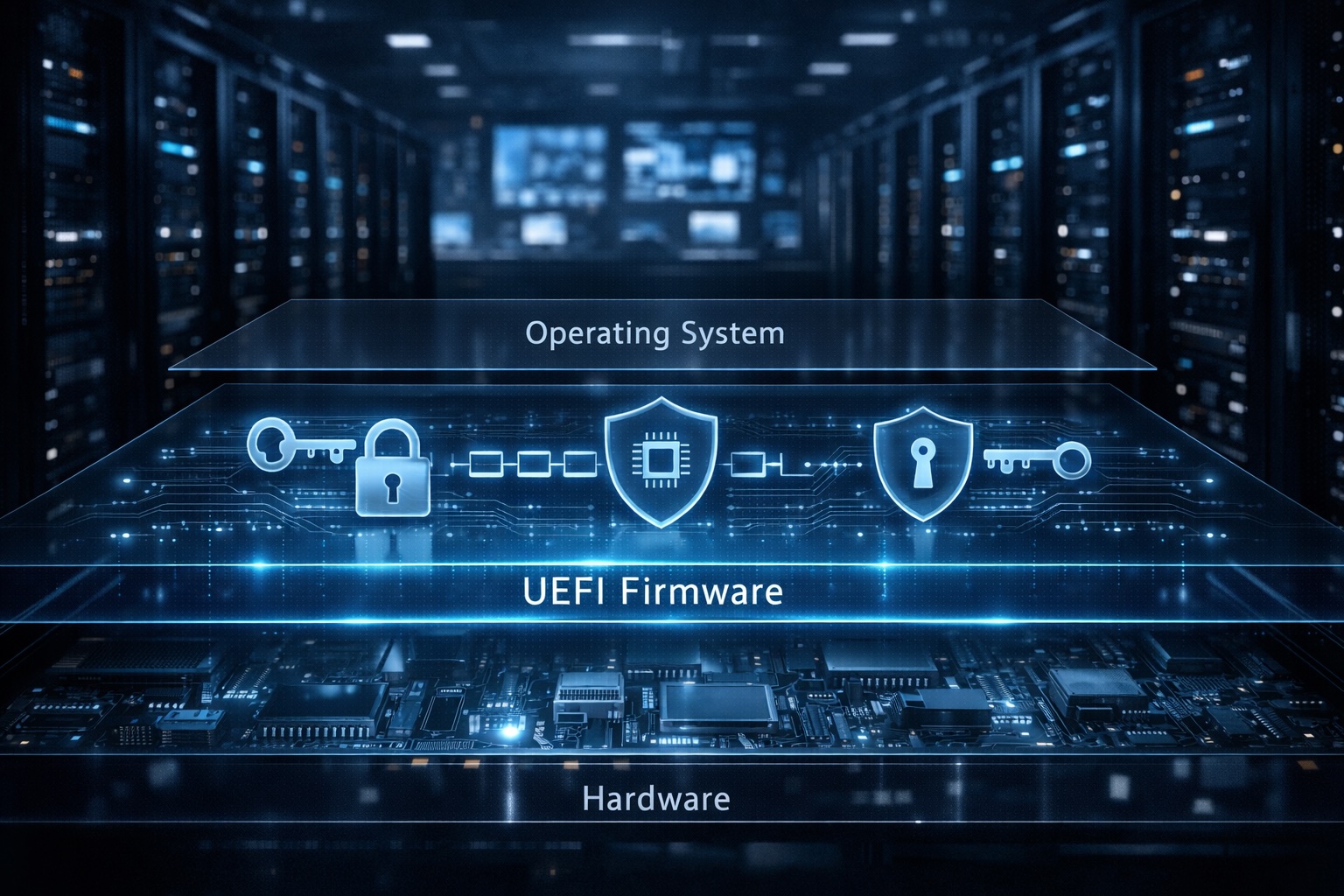
With the evolution of open standards, open specifications and open-source projects the critical embedded software and firmware components of a server or GPU or any compute platform that were originally shipped by OEM or manufacturer along with the hardware are being customized or replaced with custom firmware by organizations, especially the governments datacentres, R&D labs, critical infrastructure deployments etc. The custom firmware provides better control to optimize and suit specific environments, security, data sovereignty and hardware protection.
UEFI
The Unified Extensible Firmware Interface (UEFI) is a modern, industry-standard firmware interface that replaces the legacy BIOS, acting as the software link between a computer’s hardware and operating system. The Server or GPU system or any computing platform comes with vendor provided UEFI / BIOS pre-installed at the factory.
Custom UEFI
Governments and defence labs do build or tightly customize server UEFI either by adding layers on OEM provided firmware or by using an open firmware stack like EDK II
Why they do “custom server UEFI”
- Reduce firmware persistence risk: Firmware is a high-privilege layer and a prime target for stealthy, long-lived compromise. NIST’s platform firmware resiliency guidance frames this as a core security problem and recommends mechanisms for protection/detection/recovery at the firmware level.
- Own the trust anchors: Control of Secure Boot keys/policies (PK/KEK/db/dbx) allow an org decide exactly what can boot (OS loaders, hypervisors, option ROMs, drivers).
- Supply-chain transparency: Using open firmware components increases auditability and reduces dependence on opaque vendor code.
- Mission-specific platform constraints: Defence environments often need strict device control, deterministic boot behaviour, and hardened management paths across large fleets.
What “custom UEFI” looks like in practice
There are 3 types UEFI customization practices.
1) “Policy customization” on vendor UEFI
This is most common customization model used by governments and organizations. In this, you keep the OEM or vendor supplied UEFI, but you replace or customize Secure Boot trust:
- Replace OEM Platform Key (PK) with government/enterprise PK
- Maintain your own KEK/db/dbx policy (allow/deny list)
- Lock down boot order and removable media boot
- Enforce signed boot chain for OS/hypervisor and drivers
2) “Custom firmware builds” using an open UEFI implementation
Some organizations go further and build platform firmware using TianoCore EDK II (the open-source reference development environment for UEFI):
- Custom EDK II builds with only required modules/drivers
- Security hardening: remove unused features, reduce attack surface
- Integrate measured/verified boot extensions, attestation hooks, etc.
3) Full “sovereign firmware” standards
It’s not common, but emerging. Some countries/industry groups pursue firmware standards (separate from UEFI) intended to reduce reliance on UEFI ecosystems. Example China’s “UBIOS” initiative as a domestic push to replace conventional UEFI/BIOS. It is very rare and is far end of the spectrum.
Typical government objectives for Custom UEFI
- Hardware root of trust + secure/verified boot for firmware integrity
- Signed firmware updates only + controlled update pipeline
- Measured boot / attestation where possible (prove firmware state remotely)
- Disable/lock debug (UART/JTAG) and unnecessary UEFI drivers
- Tight Secure Boot policy ownership (government keys, curated db/dbx)
- Recovery capability (firmware rollback, known-good restore), aligned with NIST resiliency concepts
Many “custom UEFI” programs are paired with custom BMC / OpenBMC efforts because both layers are highly privileged. In modern secure designs, a root-of-trust approach (verified boot chains, measured boot) is often used across multiple firmware layers.
The future trend in 2026 and beyond is
- Shift from vendor UEFI → Policy Customization or TianoCore EDK II-based custom UEFI build
- Mandatory secure boot & signed firmware
-
- Tight Secure Boot policy ownership (government keys, curated db/dbx)
- Integration with Zero Trust
- Government push for trusted compute platforms
- Increased audits of UEFI firmware
Summary
The cloud providers, DC operators, governments, and large enterprises actively build custom UEFI for security, sovereignty, control and scale. The government-grade UEFI compliance controls and specifications are evolving to certify UEFI firmware. Governments are actively applying own security policy customization and replacing vendor provided keys on the UEFI that got shipped with the system, but going forward they may build custom UEFI based on open source EDKII platform.
Government of India Initiatives and Controls
The Government of India (MeitY, ISMS, NIC DC, CERT-In, SQTC) classified Server UEFI and BMC as critical trusted computing base (TCB). The compliance and controls in place that cover BMC and UEFI Firmware of Servers, AI systems and platforms deploying into Datacentres, Cloud etc that have strategic importance. These controls are audited before and post deployment of servers / systems to make sure firmware is secured, hardware is protected, no supply chain threats, no backdoor vulnerabilities, better control over operations and integrity of systems are maintained.
For strategic or high-assurance systems, bidders for RFPs shall support Government-owned UEFI firmware built using EDK II with secure boot, measured boot, signed updates, SBOM, and full auditability. OEM UEFI may be accepted for non-strategic systems subject to Government ownership of Secure Boot keys and compliance with the UEFI and BMC hardening baseline.
Redinent Innovations
Redinent Innovations offers extended VAPT and threat scan platform that covers IoT, OT, Edge devices and expanding to cover Servers, GPU systems, Network switches etc to audit and measure controls, provide threat assessment, weaknesses and gaps at the device level including the firmware. Redinent Innovations is building specific VAPT suite for BMC and UEFI Firmware.
Redinent Innovations is offering secured and hardened Custom BMC (based on OpenBMC) and Custom UEFI firmware stacks for various server and hardware platform architectures as needed by the customers.