
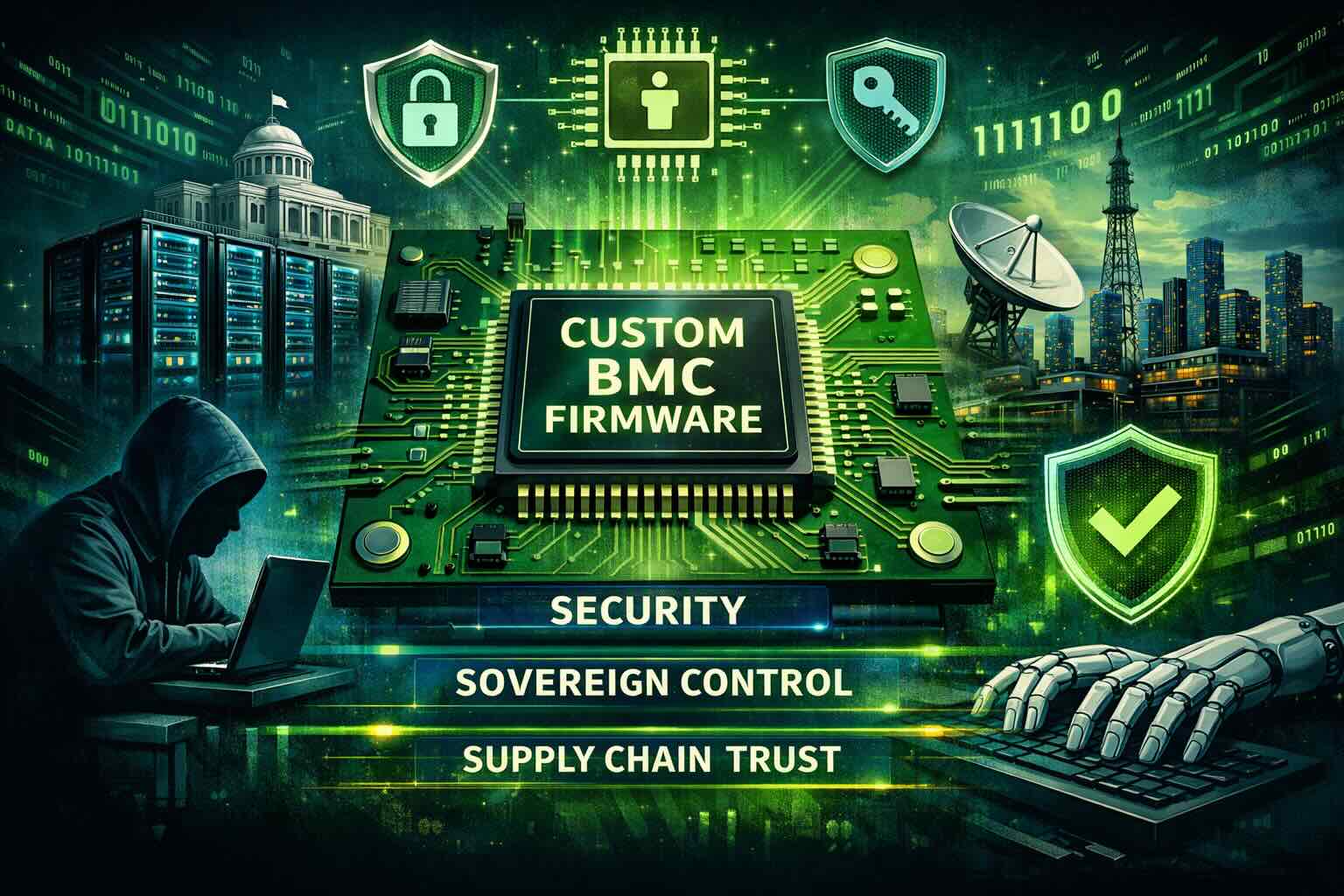
With the evolution of open standards, open specifications and open-source projects the critical embedded firmware components of a server or GPU or any compute platform that were originally shipped by OEM or manufacturer along with the hardware are being customized or replaced with custom firmware by organizations, especially the governments datacentres, R&D labs, critical infrastructure deployments etc. The custom firmware provides better control to optimize and suit specific environments, security, data sovereignty and hardware protection.
Custom BMC
A BMC is an independent microcontroller on a server motherboard that provides out-of-band remote management and security features, such as:
- Power on/off, reboot
- Power and thermal management
- Security- Silicon and Platform root of trust, Secure boot etc
- Hardware health monitoring
- Firmware updates
- Remote OS installations and driver updates
- Server Lifecycle Management
- Remote console (IPMI / Redfish)
Typically, a server from an OEM or Manufacturer comes with the built-in BMC hardware and firmware pre-installed at the factory.
A custom BMC means:
- Customized BMC firmware, or embedded management stack
- Not using the vendor’s stock BMC firmware “as-is”
With Linux Foundation’s OpenBMC project, many organizations and governments are keen to build their own BMC firmware stack. The core drivers for custom BMC implementation are:
- Security hardening
- Supply-chain trust
- Sovereign control
- Scale and automation
- Vendor lock-in reduction
BMCs are extremely sensitive because:
- They run below the Server OS (in fact parallel to the Server OS as BMC runs on a separate controller)
- They can access memory, CPU, storage, Network Controllers and other peripherals
- A compromised BMC means complete system compromise
Today, most of the Hyperscale Cloud Providers such as Microsoft, Google, Amazon (AWS), Meta, Alibaba etc; Data Centre Providers such as Equinix, NTT, STT, Government DC operators etc; Government Organizations such as Defence & intelligence infrastructure, National clouds, Strategic research labs etc; and Large Enterprises such as Banks, Telecom operators, Semiconductor fabs, Industrial automation companies etc are building their own custom BMC firmware stack. Many organizations use OpenBMC to build their custom BMC firmware.
OpenBMC – The Industry Backbone in building Custom BMC firmware
| OpenBMC Advantages | Key Features |
| Open Source | Linux based |
| Auditable | Modern REST APIs (Redfish) |
| Vendor neutral | Strong access control |
| Actively developed by hyperscalers and community | Modular architecture |
Advantages of Custom BMCs
- Security
Attack Surface Reduction
- Remove unused services (Telnet, legacy IPMI)
- Minimal OS footprint – Custom firmware features as needed
- No vendor “black box” code
Supply Chain Security
- No opaque foreign firmware
- Auditable source code
- Controlled build pipeline
Strong Identity & Access
- Hardware root of trust
- TPM / RoT integration
- Certificate-based authentication
- Role-based access control (RBAC)
- Control & Operational Benefits
Automation at Scale
- Fleet-wide firmware updates
- Fleet-wide servers’ configuration and backup
- Automated provisioning (bare metal at hyperscale)
- Hardware telemetry and diagnostics integration
Vendor Independence
- Same BMC stack across different OEMs
- Easier hardware lifecycle management
- Easy integration with 3rd party or in-house developed cloud management apps
- Compliance Alignment
- Easier mapping to:
- ISO 27001
- NIST SP 800-53
- CERT-In / STQC
- Defence security standards
Government & Sovereign Use Case
The key reasons for governments pursue custom BMCs for:
- National security
- Critical infrastructure protection
- Avoiding hidden backdoors
- Compliance with data sovereignty laws
- Complete control over firmware, certificates and keys
- Optimal code and footprint based on use case scenarios
The future trend in 2026 and beyond is
- Shift from vendor BMCs to OpenBMC-based custom stacks
- Mandatory secure boot & signed firmware
-
- Tight Secure Boot policy ownership (government keys, curated db/dbx)
- Integration with Zero Trust
- Government push for trusted compute platforms
- Increased audits of BMC firmware
Summary
The governments, cloud providers, DC operators, and large enterprises actively build custom BMCs for security, sovereignty, control and scale. Custom BMCs significantly reduce systemic infrastructure risk. OpenBMC is the dominant foundation to build custom BMCs. The government-grade BMC compliance controls and specifications are evolving to certify custom BMC firmware.