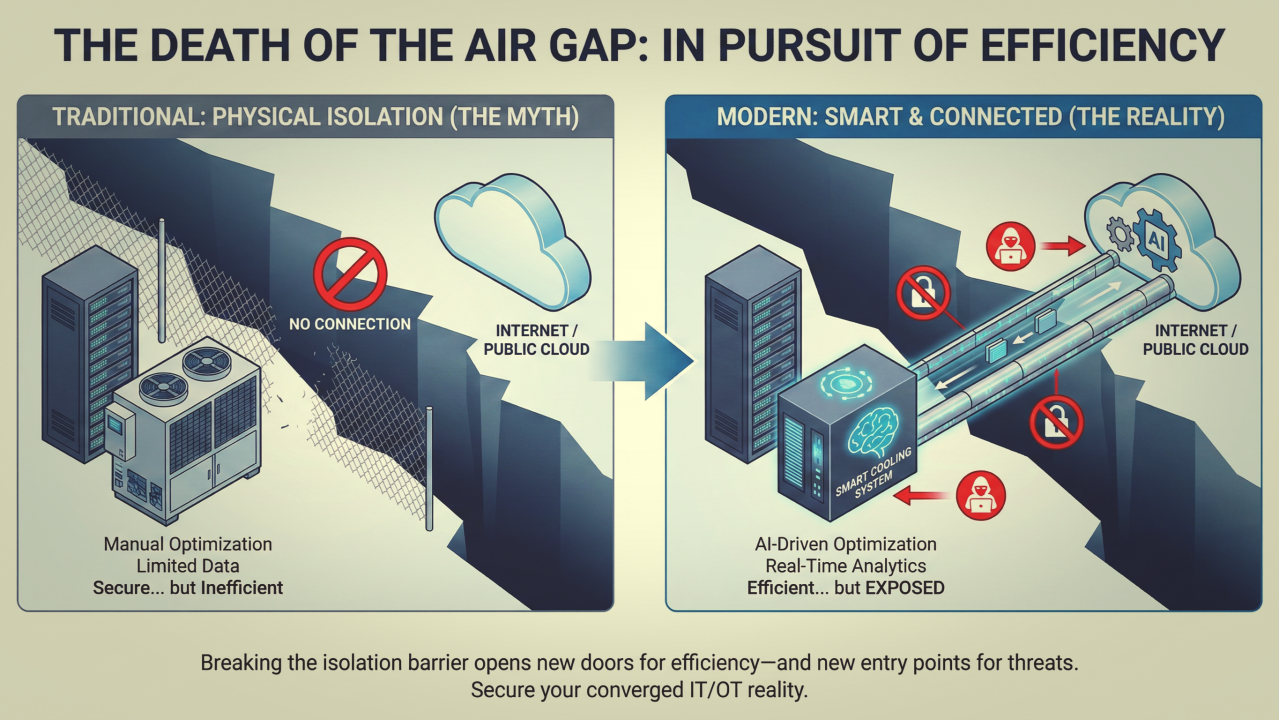
For years, we believed the “air gap”—the physical separation of critical OT systems from the internet—would save us. But as data centers chase hyper-efficiency with AI-driven cooling and smart power, we have voluntarily bridged that gap.
The risk isn’t theoretical. It’s historical. Here are three examples that prove the “nervous system” of the data center is under attack:
1. The “Burning” UPS (TLStorm)
Researchers recently discovered “TLStorm”—a set of critical vulnerabilities in APC Smart-UPS devices used in millions of server rooms.
- The Hack: Attackers could remotely take over the UPS via the cloud management interface (SmartConnect) without any user interaction (“Zero-Click”).
- The Impact: They could physically burn out the device or cut power to critical racks, bypassing all traditional IT firewalls.
2. The Cooling Control Exposure (ref-Cyble Research)
Efficiency requires connectivity, but often at a cost. Security firm Cyble discovered over 20,000 publicly exposed Data Center Infrastructure Management (DCIM) systems.
- The Hack: They found critical cooling units (like the Liebert CRV) accessible via public IP addresses, many still using default factory passwords.
- The Impact: A hacker could remotely shut down cooling units, triggering a thermal runaway that forces a total facility shutdown in minutes—no malware required, just a password login.
3. The Trojan Horse (Target)
While not a facility shutdown, the 2013 massive data breach of Target showed us the danger of OT supply chains.
- The Hack: Attackers didn’t break the front door; they stole credentials from an HVAC subcontractor (Fazio Mechanical) who had remote access for maintenance.
- The Lesson: Your security is only as strong as your vendor’s weakest password.
The question is no longer “Are we connected?” It is “Who else is on the line?”
Secure your OT. Verify your vendors. Watch your “nervous system.”
Trust Redinent XIoT
Redinent’s XIoT platform specializes in automated security assessment and vulnerability management specifically for IoT, IIoT (Industrial IoT), and embedded devices. Unlike traditional IT security scanners that focus on servers and laptops, Redinent’s platform is built to “speak the language” of the fragmented, fragile, and often insecure IoT/OT devices that run data center facility operations.
Here is how Redinent’s capabilities directly map to the Data Center security gaps identified earlier:
1. Automated Asset Discovery (Killing the “Shadow OT” Risk)
Data centers often have “ghost assets”—cameras, sensors, or PDU controllers installed by third-party vendors that IT doesn’t know about.
- Redinent’s Role: Their platform performs automated asset discovery specifically for embedded devices (CCTV, NVRs, Printers, Routers, IoT Gateways).
- Data Center Use Case: It can scan the facility network to build a real-time inventory of every IP-connected device in the cooling, power, and physical security aisles, ensuring no unauthorized “Raspberry Pi” or rogue sensor goes unnoticed.
2. Firmware & Vulnerability Intelligence (Preventing “TLStorm” & “Zero-Days”)
Standard scanners often crash legacy OT gear or miss firmware-level flaws. Redinent focuses on the firmware and configuration layer.
- Redinent XIoT maintains a specialized database of IoT/OT vulnerabilities (CVEs) and configuration weaknesses (CWEs) that are often missed by standard IT tools. It can identify outdated firmware on a specific model of an IP camera or a BMS gateway.
- Detecting TLStorm: Redinent could identify APC Smart-UPS devices running vulnerable firmware versions (e.g., due to specific TLS stack flaws) before attackers exploit them to burn out the hardware. Supply Chain Verification: Before a new batch of 500 surveillance cameras is deployed, Redinent can scan them to ensure they aren’t shipping with known backdoors or 5-year-old firmware.
3. Default Password & Credential Auditing (Stopping the “Target” Breach)
The “Target” breach happened because of weak vendor credentials. IoT devices are notorious for hardcoded passwords (e.g., admin/12345).
- Redinent XIoT includes automated checks for default, weak, or hardcoded credentials across a wide range of IoT protocols (ONVIF, RTSP, HTTP, SSH, Telnet).
- Automated Audit Capability of Redinent XIoT audit every new PDU, CRAH controller, and Camera connected to the network to ensure the default password has been changed before the device is allowed to go live.
4. Specialized CCTV & Physical Security Hardening
Physical security systems (Cameras, NVRs) are often the least secured devices in a data center, yet they sit on high-bandwidth networks.
- Redinent has deep expertise in Video Surveillance (CCTV) security, scanning for open RTSP streams, unencrypted video feeds, and NVR vulnerabilities.
- Redinent XIoT ensures that the physical security network (Physical Access Control System – PACS) doesn’t become the backdoor for a cyber attacker to jump into the corporate data network.
5. Compliance Reporting (NIS2 & ISO 27001)
With new regulations like NIS2 requiring strict supply chain security and asset management, manual spreadsheets are no longer compliant.
- Redinent’s Role: The platform provides automated reporting on the security posture of the IoT/OT fleet, mapping findings to compliance standards.
- Data Center Use Case: It allows Data Center CISOs to generate a “Facility Security Health Report” to prove to auditors that they aren’t just securing the servers inside the racks, but also the infrastructure (Power/Cooling) supporting them.
In Summary
“Redinent acts as the specialized ‘immune system’ for the Data Center’s physical infrastructure. While your EDR protects the servers, Redinent protects the Building Management Systems, Cameras, and Power Units that keep those servers running, ensuring that a $50 sensor doesn’t become the entry point for a multi-million dollar ransomware attack.”