
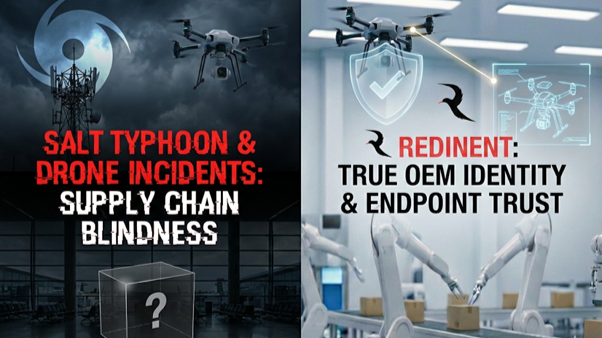
Salt Typhoon, Rogue Drones, & Weaponized Smart TVs
If late 2024 and 2025 have taught us anything—from the Salt Typhoon telecom breaches to the recent drone incursions halting European airport operations—it is this:
The “In-built trust” model for endpoint security is dead.
For CISOs, these headlines are symptoms of a deeper, systemic crisis in our Unmanned and Connected Phygital Workflows. Whether it’s a core router in a telecom grid or an autonomous drone inspecting a pipeline, the attack vector is identical: Supply Chain Blindness.
But the alarm bells aren’t just ringing in telecom and aviation. 2025 has been a wake-up call across every sector, proving that any connected device is a potential beachhead.
The 2025 IoT Threat Landscape: A Year in Review
Attacks this year shifted from data theft to physical disruption and massive scale weaponization of “shadow” assets:
- Aviation Grounded (September 2025): It wasn’t just ransomware hitting check-in systems at Heathrow and Brussels; we saw coordinated drone incursions force the closure of airspace at Copenhagen and Oslo airports. These incidents proved that physical unmanned systems can paralyze critical infrastructure just as effectively as malware.
- The Return of BadBox (June 2025): The FBI warned of BadBox 2.0, a resurrected botnet that compromised over a million Android-based streaming boxes and smart TVs. Attackers used pre-infected firmware in “off-brand” devices to create a massive residential proxy network for fraud and DDoS attacks, hiding inside living rooms worldwide.
- Healthcare Firmware Flaws: The FDA issued critical alerts regarding cybersecurity vulnerabilities in patient monitors from manufacturers like Contec and Epsimed. With 99% of hospitals reported to have exposed IoMT devices in 2025, the risk has moved from patient data privacy to immediate patient safety.
- The Grid at Risk: Research uncovered that seemingly harmless solar inverters in residential and commercial arrays could be “chained” together by attackers to destabilize national power grids, turning green energy hardware into a kinetic weapon.
- “Voyeurism at Scale”: In Italy, a conviction involving the distribution of footage from thousands of unsecured smart cameras revealed how attackers are scanning the internet for factory-default credentials to invade privacy on an industrial scale.
The Common Denominator: Blind Trust
These aren’t isolated incidents. They are proof that attackers didn’t break down the front door; they walked in through:
- Compromised Firmware: Pre-implanted backdoors in “trusted” hardware supply chains.
- White-Label Obscurity: Critical devices running vulnerable code from unknown, unvetted OEMs.Legacy & Shadow Assets: Unmanaged endpoints that no one knew existed until they were weaponized.
As we automate our industries with robotics, drones, and IIoT, we are expanding this attack surface exponentially. You cannot secure an autonomous future if you don’t know the true identity of the machine making the decisions.
And this is why Redinent Innovations exists.
At Redinent, we go beyond standard scanning. We strip away the label to reveal the True OEM identity and firmware DNA of your endpoint devices. We validate the integrity of the “things” in your XIoT—ensuring that the drone flying over your facility, the camera watching your lobby, or the sensor running your line is exactly what it claims to be.
In 2025, security isn’t about the perimeter. It’s about Endpoint Trust.
Don’t wait for your own “Salt Typhoon” moment.
👉 Verify your Unmanned autonomous endpoint devices today with us.