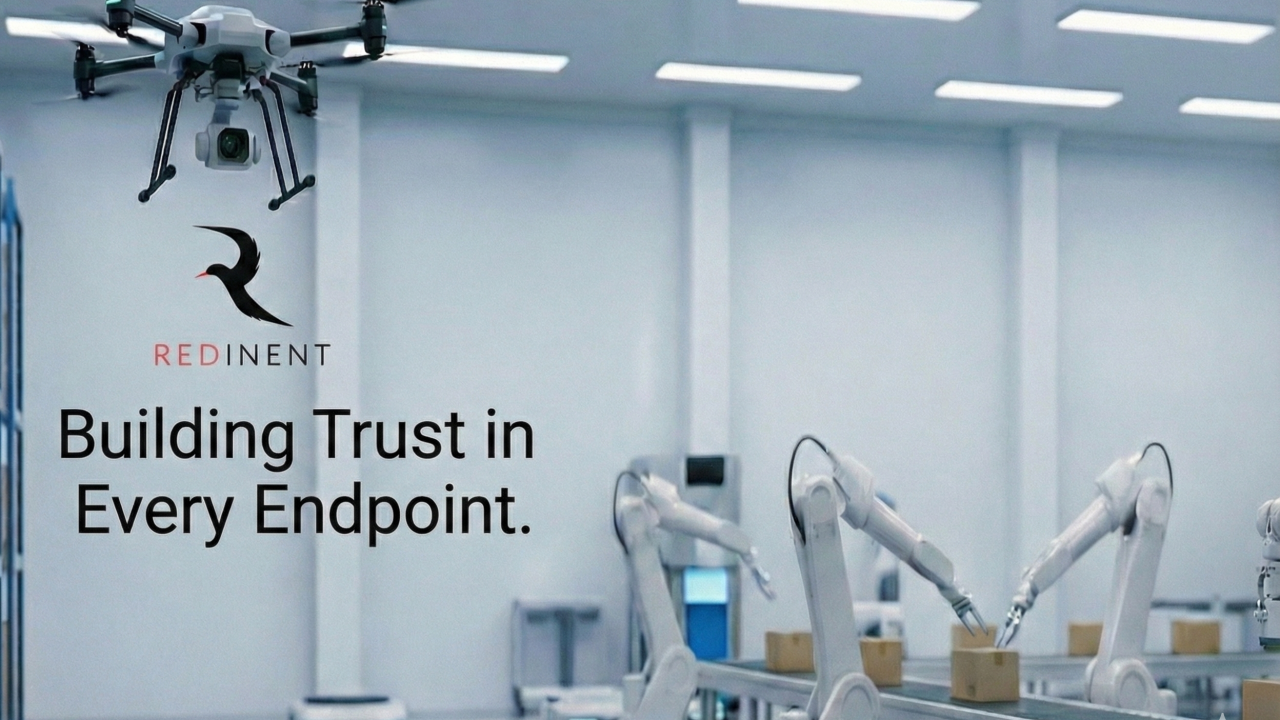
The future isn’t just coming; it is already automating.
We are standing on the precipice of a fundamental shift in how the industrial world operates. It is the era of the Unmanned Workflow. From autonomous drones inspecting high-voltage power lines to Automated Guided Vehicles (AGVs) navigating the complex lattice of a smart warehouse, and from remote CCTV surveillance grids monitoring critical infrastructure to robotic arms assembling the next generation of EVs—the human operator is stepping back.
We are handing the keys over to algorithms, sensors, and actuators. We are trading manual oversight for speed, precision, and relentless efficiency.
But as we remove the human element from the loop, we create a vacuum. And in the world of cybersecurity, vacuums are dangerous things. The question we must ask ourselves is not just “Does it work?” but “Can we trust it?”
The Hidden Crisis of Trust in Endpoint Devices
In a manned workflow, a human operator can spot an anomaly. They can override a malfunctioning system. They can pull the plug. In an unmanned workflow, the device is the decision-maker.
If you cannot trust the endpoint, you cannot trust the mission.
The reality of the modern Internet of Things (IoT) is that it is a “black box” ecosystem. Supply chains are convoluted. A camera branded by Company A might be running firmware developed by Company B, on hardware manufactured by Company C.
This is the “White Label” problem, and it is the Achilles’ heel of unmanned security.
Traditional IT security tools are blind to this. They see an IP address. They might see a MAC address. But they don’t see the identity of the device. They don’t know that the “secure” sensor you just deployed has a hardcoded backdoor in its underlying OEM firmware—a vulnerability that was patched in the original brand but ignored in the rebranded version you bought.
In an unmanned future, this kind of blindness is catastrophic. A compromised drone doesn’t just lose data; it can crash into a crowd. A hacked industrial controller doesn’t just slow down production; it can cause physical destruction.
Building Trust Where It Matters: The Endpoint
This is where Redinent steps in. We realised early on that to secure the unmanned future, we needed to build a platform that didn’t just monitor traffic but fundamentally built trust in the endpoint devices themselves.
Redinent’s XIoT Platform is engineered to solve the specific challenges of securing the “things” in the Internet of Things.
1. Unmasking the Identity with Deep Asset Intelligence (DAI)
Trust starts with truth. You cannot secure what you do not know. Redinent’s proprietary Deep Asset Intelligence engine goes deeper than any traditional scanner. We don’t just accept the device’s banner at face value. Our patent-applied algorithms analyze the TCP stack, perform deep packet inspection, and look at application-layer signatures to discover the True OEM identity of a device.
We strip away the white-label branding to reveal the actual firmware and hardware beneath. This allows us to apply the correct security tests, not generic ones, ensuring that we aren’t giving you a false sense of security.
2. Context-Aware Vulnerability Intelligence
Generic vulnerability scanners are noisy and often dangerous for sensitive OT environments. You can’t just “ping sweep” a delicate industrial controller. Redinent’s platform uses Context-Aware security modules. Once we identify the specific device—say, a specific model of CCTV camera or a particular industrial router—we launch innovative, customized attack vectors designed solely for that device type.
This allows us to validate risks with surgical precision. We don’t just tell you “this port is open.” We tell you, “This specific firmware version on your unmanned surveillance unit has a known authentication bypass vulnerability, and here is the evidence.”
3. From Passive Monitoring to Active Assurance
In an unmanned workflow, passive monitoring is not enough. You need active assurance. Redinent provides continuous, automated security assessments that act as a digital immune system for your fleet. Whether it’s ensuring compliance with NIST and ISO 27001 standards or validating that a new firmware update hasn’t introduced a regression, our platform keeps the trust level high, 24/7.
The Pilot of the Future is Security
As we move toward a world where our infrastructure runs itself, the role of cybersecurity shifts from “protector” to “enabler.”
At Redinent, we architect the trust layer that allows these unmanned systems to exist. We are giving organizations the confidence to deploy that fleet of drones, to activate those remote sensors, and to trust the data coming from the edge.
The future is indeed all unmanned. But it doesn’t have to be unknown.
With Redinent, you aren’t just deploying devices; you are deploying verified, hardened, and trusted endpoints. Because in a future without pilots, security is the only thing steering the ship.
Is your business flying blind?
Discover how Redinent’s Deep Asset Intelligence can secure your Endpoint Ecosystem.